
Spelling in English is notoriously tricky for beginners. Irregular patterns, silent letters, and sound–letter mismatches can frustrate even the most motivated students. For teachers, knowing how to approach spelling instruction can be the difference between learners who struggle for years and those who gain confidence quickly.
A recent peer-reviewed study, Spelling error analysis in young English language learners from a German background: A comparison of three literacy intervention programmes (Mlakar, Hirst-Plein & Koch, 2024), tracked 75 primary pupils over two years to compare three teaching approaches—phonics, whole-word, and a combined method—on spelling, vocabulary, and reading fluency.
Although the research focused on German learners, the results carry lessons for EFL/ESL classrooms worldwide. All groups reached similar spelling accuracy by the end, but the phonics group developed stronger vocabulary knowledge, and the combined group achieved faster reading speeds. Most mistakes were sound-based or influenced by the learners’ first language, with phonics teaching leading to fewer such errors overall. This matters for all teachers because it shows that structured phonics teaching—especially when paired with ready-made practice resources like phonics flashcards and vowel team worksheets—can help beginners build a solid foundation in spelling.

Overview of the Study:
Mlakar, Hirst-Plein and Koch (2024) used a quasi-experimental, longitudinal design with 75 primary pupils,, with each group following one of three approaches for two academic years. These were:
- Phonics – explicit teaching of grapheme–phoneme correspondences (GPCs), enabling pupils to decode and encode unfamiliar words.
- Whole-word – memorising words as complete visual units.
- Combined – a structured mix of phonics with targeted whole-word teaching for irregular, high-frequency words.
During the study, lessons took place twice a week, and progress was measured through reading, vocabulary, and spelling accuracy tests, which included both real and made-up words.
Phonics and Whole-Word Methods Explained:
Phonics: A method that teaches learners the relationship between letters (or letter combinations) and the sounds they represent. This equips students to read and spell unfamiliar words by breaking them down into sound–letter parts. Systematic phonics is widely recognised as one of the most effective ways to improve literacy in both first and second language contexts (National Reading Panel, 2000).
Whole-word: Also known as sight-word instruction, this focuses on teaching learners to recognise entire words instantly. It’s particularly useful for words that don’t follow standard spelling rules.
Combined: A planned blend of the two—phonics for most words and whole-word for tricky, irregular ones.
If you’re teaching phonics for the first time, starting with a structured set of phonics pattern flashcards will make the process easier and more consistent for your learners.
What the Study Found:
- Spelling accuracy – All three groups reached similar accuracy on real and made-up words.
- Vocabulary – The phonics group achieved the largest vocabulary gains.
- Reading fluency – The combined approach produced the fastest reading speeds.
- Error patterns – Most errors were sound-based or influenced by the learners’ first language, but the phonics group made the fewest of these.
How This Fits with Other Research:
The results of the study by Mlakar, Hirst-Plein & Koch are not isolated and are supported by other research into how to best teach young EFL and ESL learners spelling. In fact, similar findings have been reported across many different language backgrounds. Examples include:
- Chinese EFL learners gained 10% higher reading and vocabulary scores after phonics-based instruction (Hu & Du, 2023).
- Adult ESL learners improved their spelling accuracy significantly with targeted phonics training (Martin, 2024).
- A meta-analysis shows that systematic phonics improves spelling, reading fluency, and phonological awareness for learners of all ages (National Reading Panel, 2000).
Practical Takeaways for Teachers:
- Make phonics a cornerstone of your early teaching – Teach sound–letter patterns explicitly and contrast them with learners’ first language spelling rules to reduce errors.
- Use whole-word strategically – Teach irregular high-frequency words as wholes, but don’t let this replace systematic phonics.
- Target vowel team patterns early – Many beginner errors come from vowel digraphs (e.g., ea, ai, ou). Using targeted vowel team worksheets ensures repeated, structured practice until mastery.
- Track error types – Keep simple records of phonological vs. orthographic errors so you can focus your teaching where it’s most needed.
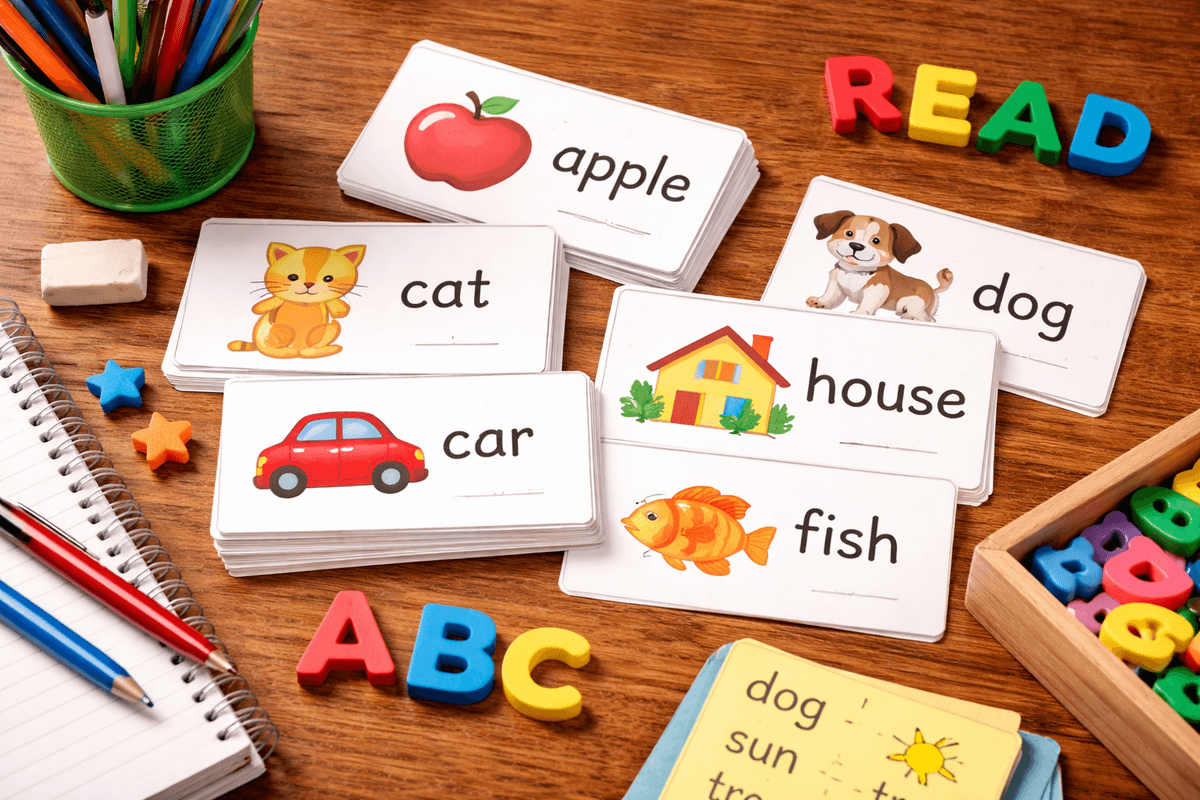
EFL Teaching Tools That Support This Approach:
Research shows that phonics works best when learners get lots of short, focused practice. This is where targeted teaching materials make a real difference.
- Phonics flashcards help students master GPCs and vowel teams quickly through visual cues and repetition.
- Vowel team worksheets give structured, repeated exposure to tricky letter combinations.
- Phonics games and matching activities keep practice engaging, especially for younger learners.
If you want to save lesson prep time and keep activities research-aligned, our store has a collection of phonics and vowel team resources that are ready to use straight away in beginner EFL/ESL classrooms.
They have been designed to work together in the classroom, and are based on the Phonics and Vowel Sounds taught in the Oxford English Phonics Books, so are especially suited to make a great companion for any EFL teacher using that book. A sample lesson using them might look something like this:
Sample Weekly Plan for Two Forty-Five Minute Lessons
- Phonics focus (10 min) – Introduce one new GPC or vowel team pattern.
- Practice (15 min) – Use flashcards to blend and segment target words.
- Fluency (10 min) – Timed reading of target words and irregular sight words.
- Application (8 min) – Short writing task using new words, with peer correction.
- Review (2 min) – Quick spelling check of one regular and one irregular word.
Conclusion:
Whether your learners are 7 years old or 70, a strong foundation in phonics is essential for building confident spellers. Combine it with targeted whole-word work and plenty of practice on vowel team spelling patterns, and you’ll see gains not just in spelling accuracy, but also in vocabulary and reading fluency.
If you’re ready to put these findings into practice, you can explore my phonics flashcards, vowel team worksheets, and other spelling pattern resources—all designed for beginner EFL/ESL learners and aligned with the research discussed here.
References:
- Hu, X. & Du, H. (2023) ‘The impact of phonics instruction on phonemic awareness, reading, and vocabulary abilities in EFL learners’, English Language Teaching, 16(6), pp. 186–194.
- Martin, K.I. (2024) ‘How a phonics-based intervention, L1 orthography and item characteristics impact adult ESL spelling knowledge’, Education Sciences.
- Mlakar, H., Hirst-Plein, J. & Koch, M.J. (2024) ‘Spelling error analysis in young English language learners from a German background: A comparison of three literacy intervention programmes’, Journal of the European Second Language Association, 8(1), pp. 131–147. Available at: https://euroslajournal.org/articles/10.22599/jesla.113 (Accessed: 9 August 2025).
- National Reading Panel (2000) Teaching children to read: An evidence-based assessment of the scientific research literature on reading and its implications for reading instruction. Washington, DC: National Institute of Child Health and Human Development.
- PedagogyNongrata (2023) Phonics vs Whole Language: Effect size comparison.