
Few classroom approaches have been researched as extensively as Cooperative Learning. The research tradition behind Cooperative Learning and social interdependence stretches back more than a century and includes more than 1,200 research studies examining cooperative, competitive and individualistic ways of learning.
And the benefits identified by that research go far beyond simply getting students to work together.
Cooperative Learning has been associated with:
- higher academic achievement
- better retention of learning
- stronger higher-order thinking
- improved problem-solving
- greater participation
- increased engagement and time on task
- more positive attitudes towards learning
- stronger peer relationships
- improved social and communication skills
- greater helping and prosocial behaviour
- increased empathy
- improved relationships across racial, ethnic and cultural groups
- greater inclusion and peer acceptance
- higher self-esteem and confidence
- reduced bullying and victimisation
- reduced stress and improved wellbeing
- greater academic support between students
- and particularly valuable opportunities for language learners to communicate
That is an unusually broad collection of outcomes for a classroom teaching approach. So what does the research actually show?
1. Higher academic achievement
Academic achievement is one of the most consistently researched benefits of Cooperative Learning.
A major meta-analysis by Kyndt et al. (2013) examined 65 studies of face-to-face Cooperative Learning. It found a weighted average effect size of 0.54 for academic achievement. That result was remarkably consistent with earlier research syntheses. Kyndt and colleagues noted previous achievement effect sizes of approximately 0.51, 0.51 and 0.55 in other major reviews.
More recently, a 2026 second-order meta-analysis went further by combining the findings of 15 previous meta-analyses. It found an overall positive effect of 0.71 across learning outcomes, including academic achievement, higher-order thinking and affective outcomes.
And the evidence does not come from one age group or one subject.
Cooperative Learning has been successfully investigated in mathematics, science, languages, social studies, literacy, physical education and higher education, among others. Put simply students learn more when learning is structured cooperatively.
2. Better higher-order thinking
The benefits are of cooperative learninig are not restricted to remembering information or improving test scores. Its methods also requires learners to explain, justify, compare, question, evaluate and solve problems together.
The 2026 second-order meta-analysis found that the largest effect among the learning outcomes it examined was for higher-order thinking, even exceeding the effect for academic achievement. This includes abilities such as critical thinking, creative thinking and problem-solving.
There is a logical reason for this: Being told an answer and being able to explain an answer are not the same cognitive task. And when students have to explain an idea to another person, defend a choice, compare alternative answers or help a teammate understand something, they are forced to process the material more deeply.
Cooperative Learning therefore changes more than the social arrangement of the classroom. In short: It changes what students have to do with their thinking.
3. Better problem-solving
Problem-solving is another area that has its own substantial research history within Cooperative Learning. Previous meta-analytic research examined cooperative versus individual approaches to problem-solving and found advantages for cooperation, while more recent research continues to find benefits for areas including mathematical problem-solving, procedural fluency and conceptual understanding. Again, the mechanism is important:
- A learner solving a problem alone has access to one line of reasoning: their own.
- A cooperative team can expose learners to multiple approaches, mistakes, explanations and possible solutions.
With Cooperative Learning, students do not simply produce answers to questions. They encounter different ways of reaching them.
4. Better retention of learning
Learning something today is of little value if it has disappeared next week. Research has also found improved retention following Cooperative Learning.
A study conducted at An Giang University in Vietnam, for example, found that students taught cooperatively scored an average of 76.31 on a delayed retention test, compared with 65.87 for students receiving lecture-based teaching (Tran, 2014).
Similarly, Tanel and Erol (2008) found that students taught using Jigsaw retained around 98% of their learning four weeks later, compared with around 80% for students taught conventionally.
The evidence therefore suggests that Cooperative Learning can improve both academic achievement and subsequent knowledge retention—likely because explaining, retrieving and discussing knowledge with peers requires students to repeatedly access information rather than merely encounter it once.
5. Dramatically more opportunities to participate
This may be the most immediately visible difference between Cooperative Learning and traditional classroom questioning. Imagine a class of 31 students. The teacher asks a question and one student is selected to answer. The number of students actively participating in that exchange is 1.
Now restructure the activity so that every learner must formulate an answer and share it with another, using cooperative learning. Sunddenly the number of students actively responding leaps up to 31.
That is potentially 3,000% more students actively responding during the activity cycle. And the figure does not come from a research study. It is simply mathematics:
1 participating student → 31 participating students = a 3,000% increase. And this distinction gets to the heart of Cooperative Learning.
A teacher may be asking excellent questions, but if students answer them one at a time, participation is inherently restricted. Cooperative learning sstructures allow participation to occur simultaneously. And instead of repeatedly asking: “Who knows the answer?” we begin asking “Which structure am I going to use today that allows the whole class to answer?”
6. More student talk and communication
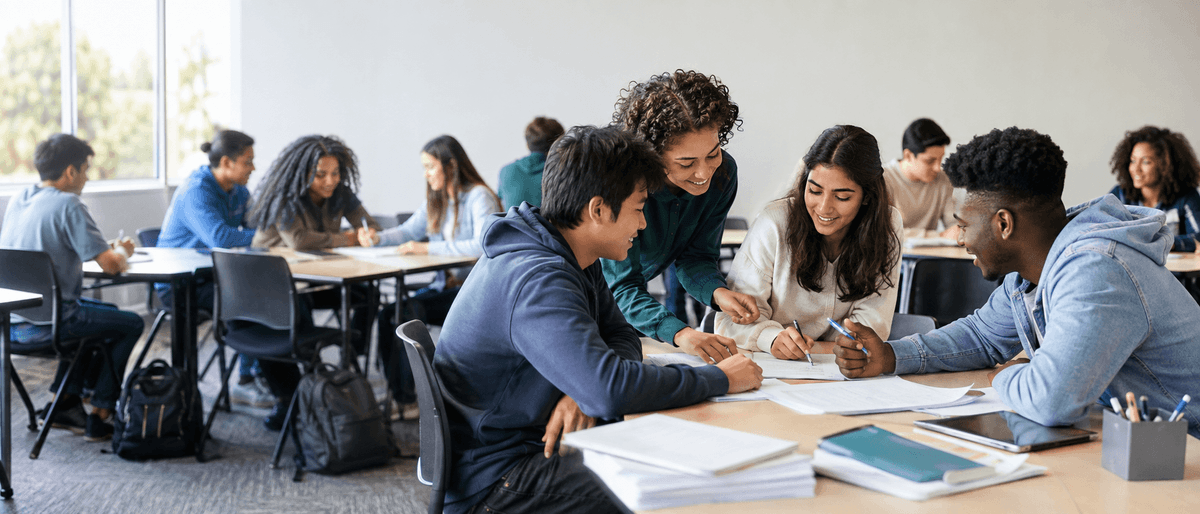
This becomes particularly important where speaking itself is part of the learning. In traditional whole-class interaction, only one learner can normally speak to the teacher at a time. Put 32 students into pairs, however, and potentially 16 conversations can occur at once.
Research into second-language learning has long found that learner-to-learner interaction creates more opportunities to produce language. Long et al. (1976) found that EFL learners produced more language and used a wider range of language functions in small groups, while Pica and Doughty (1985) similarly found increased language production during group interaction.
Cooperative Learning therefore creates repeated opportunities for learners to process both language input and output through interaction with classmates, making it particularly valuable in EFL, ESL and other language classrooms. Because students cannot learn to communicate in a language without the chance to use it.
7. Greater engagement and time on task
Participation and engagement are closely connected. If students know that they may need to explain an answer, report a teammate's idea, or solve part of a problem in order to contribute to their team's success, disappearing from the lesson becomes considerably more difficult.
Research has found increased on-task behaviour, academic engagement and persistence under cooperative approaches.
Meta-analytic work in science, mathematics, engineering and technology found benefits not only for achievement but also for students' persistence in their studies. And recent research has also identified increased classroom engagement and peer academic support following Cooperative Learning interventions.
The student stops being merely an audience member. They have a job to do.
8. More positive attitudes towards learning
Cooperative Learning can also affect how students feel about their lessons.
Kyndt et al.'s meta-analysis found a significant positive effect on student attitudes, while similar reviews have found positive effects on attitudes towards learning, individual subjects and courses.
The Vietnamese Jigsaw study similarly found favourable student responses towards learning cooperatively, which isn't surprising, as learning becomes a more socially active experience. with students talking, solving, comparing, helping, moving, deciding and contributing rather than simply receiving information.
9. Stronger peer relationships
One of Cooperative Learning's strongest benefits has nothing to do with examination scores. A landmark meta-analysis by Roseth, Johnson and Johnson (2008) analysed 148 studies involving more than 17,000 early adolescents across 11 countries and four multinational samples, and revealed it improves how students relate to one another..
Cooperative goal structures were associated with both higher achievement and more positive peer relationships than competitive or individualistic structures. A combination which is important because it suggests that academic success does not have to come at the expense of classroom relationships. Cooperative Learning improves both.
10. Students become sources of support for each other
In a traditional classroom, the teacher can easily become the main (or sometimes only) source of help. Cooperative Learning changes that, as students learn to ask one another questions, offer explanations, check understanding, provide feedback, coach each other, and help their teammates succeed.
Recent studies by Van Ryzin and colleagues (2020; 2040) suggests Cooperative Learning to increase peer academic support alongside improvements in peer relationships and engagement, which fundamentally changes the classroom dynamic.
Instead of: 30 students → 1 teacher, the classroom begins to contain an entire network of potential knowledge, help and support.
11. Better social and teamwork skills
Of course, cooperation itself is a skill you can practice. Listening, turn-taking, disagreeing appropriately, explaining, encouraging, negotiating, making decisions, compromisingm and resolving conflict all require practice. Which structured Cooperative Learning repeatedly provides.
Johnson and Johnson's model of Cooperative Learning explicitly identifies interpersonal and small-group skills—including leadership, decision-making, trust building, communication and conflict management—as central elements of successful cooperation.
A 2025 meta-analysis in physical education provides a particularly clear modern example. Across 40 studies involving 3,985 students, Cooperative Learning produced positive outcomes across cognitive, affective, physical and social domains.
The largest effect was in the social domain: 0.612.
Students do not become better at working with others simply because we tell them teamwork is important. Like most things, they become better at it by repeatedly doing it.
12. More helping and prosocial behaviour
Good Cooperative Learning makes helping other people a productive thing to do. If my teammate's understanding contributes to our shared success, helping them is no longer something that distracts from my own learning. It becomes part of it.
A large school-based Cooperative Learning research programme has found increased prosocial behaviour, including positive and supportive behaviour towards peers. This is a profound change from competitive classroom structures which can have a negative impact on learning (Roseth, Johnson & Johnson, 2008).
One of the key take aways of cooperative learning is that another student's success does not mean my success less likely. In fact, their success will most likely contribute to mine.
13. Greater empathy
The same research programme has also connected Cooperative Learning with increased empathy. When students repeatedly work with classmates, listen to their ideas, depend on their contributions and encounter their difficulties, the other student becomes less abstract. They become someone whose perspective matters.
Research with middle-school students has found Cooperative Learning to improve both peer relationships and empathy, with those changes subsequently connected to reductions in bullying. This gives Cooperative Learning an important social role that stretches considerably beyond the curriculum with potentially huge societal impacts.
14. Better relationships across racial, ethnic and cultural groups
A 2024 meta-analysis examined Cooperative Learning and intergroup relationships. It brought together 18 field experiments involving 5,265 participants and a found significant positive effect on relationships between members of different social groups, with an overall effect size of 0.33.
This builds on decades of earlier research showing that when students from different racial or ethnic backgrounds are placed in situations where they genuinely need and support one another, cross-group relationships improve. This could potentially have obvious significance for international schools and other culturally diverse classrooms.
Simply placing children from different countries, ethnicities, languages and cultural backgrounds inside the same building does not necessarily mean they will build meaningful relationships with one another. But Cooperative Learning deliberately creates those opportunities, meaning students who might otherwise remain within familiar friendship, nationality or language groups are repeatedly placed into situations where they:
- work towards a shared objective
- depend upon one another
- exchange ideas
- solve problems together
- recognise one another's strengths
- and experience success together
In a genuinely international classroom, that may be one of Cooperative Learning's most valuable benefits. It doesn't simply make a classroom diverse. It makes that diversity cooperative.
15. Greater inclusion and peer acceptance
The same principle applies to students who may otherwise become socially marginalised, with Cooperative Learning being shown to improve peer acceptance of students with learning disabilities in inclusive settings.
This is supported by Kyndt et al.'s review which identifies improved acceptance of mainstreamed classmates among the established outcomes associated with Cooperative Learning.
Again, there is a powerful mechanism behind this. A student who may be seen primarily through a difference or difficulty can become:
- the person who has the information we need
- the teammate who explains something
- the person responsible for this part of our task
Or quite simply: someone I regularly work with. Across all the evidence we repeatedly see that Cooperative Learning gives students opportunities to become valuable to one another.
16. Higher self-esteem and confidence
Research on Cooperative Learning has also repeatedly identified benefits for self-esteem and students' perceptions of themselves. Many reviews have identified enhanced self-esteem among the established outcomes of Cooperative Learning, alongside achievement, intergroup relationships and positive attitudes.
This is understandable, as Cooperative Learning structures create large amounts of small opportunities to contribute successfully. Because a cooperative classroom means a student does not need to be the fastest learner in the room or confident enough to raise their hand in front of 30 classmates to participate meaningfully.
They can explain something to one partner, offer one idea, read one question, coach a teammate, or contribute a small piece of information or correction. And for young learners especially, repeated experiences of being listened to and having something useful to contribute matter.
17. Reduced bullying and victimisation
Cooperative Learning has also been investigated as a way of changing the peer environment in which bullying develops. For example, a two-year cluster-randomized Cooperative Learning intervention in middle schools found effects on peer relationships, victimisation and bullying, with subsequent analyses showing links between improved peer relations, empathy and reductions in bullying.
The Cooperative Learning intervention is now listed by the Blueprints evidence registry for outcomes including bullying, close peer relationships and positive/prosocial behaviour. And there is a clear underlying logic: Bullying thrives in classrooms where peer relationships are hierarchical, isolated or adversarial, while Cooperative Learning repeatedly restructures those relationships around shared goals and mutual support.
18. Reduced stress and improved wellbeing
The effects of cooperative learning extend further still. Longitudinal research from the same Cooperative Learning programme has examined relationships between victimisation, stress, mental health and academic engagement. The findings indicate that reducing problematic peer experiences through Cooperative Learning can also influence stress, emotional wellbeing and students' engagement with school.
This reminds us that academic learning does not take place separately from students' social lives.A learner who feels supported by classmates experiences a fundamentally different classroom from one who feels socially threatened or isolated.
19. Greater equity
One of the biggest benefits of Cooperative Learning is that is changes who gets access to classroom participation and academic support. It's recognised that traditional classroom methods of interaction can unintentionally favour students who are faster, more confident, more linguistically fluent, more willing to raise their hands, or already achieving highly (Good & Brophy, 1987).
Structured Cooperative Learning, on the other hand, is desigend to distribute participation much more fairly and deliberately. Research from the large middle-school Cooperative Learning trial found particularly strong improvements in peer relations, academic support and engagement among students of colour, with researchers highlighting Cooperative Learning's potential to reduce disparities within education (Van Ryzin, Roseth, & Mc Clure, 2020).
And this connects to another fundamental feature of well-designed Cooperative Learning: equal participation does not mean expecting every student to be identical. It means structuring learning so that every student has a meaningful opportunity—and responsibility—to contribute.
20. Particular benefits for language learners
For finally, we come to why I fell in love with Cooperative Learninig. If you're an EFL or ESL teacher, or teach any foreign language for that matter, many of these benefits come together and compounds. Language learners need opportunities to speak, comprehensible input, meaningful output, repetition, feedback, interaction, confidence, and reasons to communicate meaningfully.
When implemented well, Cooperative Learning provides all of these.
Research into cooperative language learning reports increased opportunities for learners to produce and process language, greater quantities and varieties of speech, improved speaking performance and supportive environments in which learners can communicate with less pressure than in teacher-fronted interaction (Long & Porter, 1985; Pica & Doughty, 1985).
And because multiple conversations can take place simultaneously, Cooperative Learning tackles one of the fundamental limitations of the language classroom: there is only one teacher in the classroom but every student needs to speak.
How can one teaching approach produce so many benefits?
At first glance, it might seem surprising that one classroom approach can affect everything from achievement and critical thinking to peer relationships and bullying. But Cooperative Learning does not change just one thing. It changes the interaction structure of the classroom. Students move from:
- listening → explaining
- watching → participating
- working beside classmates → working with them
- depending mainly on the teacher → supporting one another
- competing for attention → sharing responsibility
- one student answering → many students responding simultaneously
- being responsible only for themselves → being accountable to a team
Those changes affect how often students retrieve information, how much they explain, how deeply they process ideas, how frequently they communicate and how they relate to the people around them. That provides a plausible explanation for the extraordinary range of outcomes found across the Cooperative Learning research.
Group work is not Cooperative Learning.
There is a big distinction that matters, and which people who are new to cooperative learning, don't understand what it is, or are aware of it but don't use it, often don't understand. And that is that putting students into groups does not automatically create Cooperative Learning. Badly structured group work can still contain:
- one student doing everything
- another student doing nothing
- stronger students dominating
- weaker students copying
- unequal participation
- very little genuine cooperation
- a variety of other issues and barriers to learning
However, effective Cooperative Learning deliberately structures the interaction of groups, which is why across all the influential structures and models, the four core principles of the method always occur, and we find all of the following:
- positive interdependence — students need one another;
- individual accountability — every student remains responsible;
- equal participation - every student equally involved in the work
- simultaneous interaction - the whole class working at the same time
- active interaction — students explain, question, respond and support;
- social skills — students learn how to cooperate effectively;
- and reflection or group processing — teams consider how well they worked together.
This clear distinction explains why Cooperative Learning can achieve outcomes that ordinary group work often does not.
The bigger picture
The case for Cooperative Learning is not based on one experiment, one researcher or one educational trend. It rests on decades of research conducted across different countries, subjects, age groups and educational settings. The huge body of research connects properly structured Cooperative Learning with all of the following:
- better achievement.
- deeper thinking.
- better retention.
- greater participation.
- more student talk.
- greater engagement.
- stronger peer support.
- better social skills.
- improved relationships between different groups.
- greater inclusion.
- increased empathy and prosocial behaviour.
- higher confidence.
- less bullying and victimisation.
- and healthier classroom relationships.
And that is what makes Cooperative Learning so much more than just a way of organising students into teams. Why it's so much more powerful than ordinary group work. It is a way of redesigning who participates, who communicates, who supports whom, and ultimately who gets the opportunity to learn.
References:
- André, A., Deneuve, P., & Louvet, B. (2011). Cooperative learning in physical education and acceptance of students with learning disabilities. Journal of Applied Sport Psychology, 23(4), 474–485.
- Blueprints for Healthy Youth Development. (n.d.). Cooperative Learning. Blueprints Programs.
- Boke, H., Aygun, Y., Tufekci, S., Yagin, F. H., Canpolat, B., Norman, G., Prieto-González, P., & Ardigò, L. P. (2025). Effects of cooperative learning on students’ learning outcomes in physical education: A meta-analysis. Frontiers in Psychology, 16, 1508808.
- Good, T. L., & Brophy, J. E. (1987). Looking in classrooms (4th ed.). Harper & Row.
- Güngör, F., Altunbaşak, İ., Aydın, A. T., Kaya, M., & Erdem, C. (2026). A second-order meta-analysis on the effects of cooperative learning on students’ academic achievement, higher-order thinking, and affective behaviors. Current Psychology, 45, 552.
- Haydon, T., Maheady, L., & Hunter, W. (2010). Effects of Numbered Heads Together on the daily quiz scores and on-task behavior of students with disabilities. Journal of Behavioral Education, 19, 222–238.
- Johnson, D. W., & Johnson, R. T. (2002). Learning together and alone: Overview and meta-analysis. Asia Pacific Journal of Education, 22(1), 95–105.
- Johnson, D. W., & Johnson, R. T. (2009). An educational psychology success story: Social interdependence theory and cooperative learning. Educational Researcher, 38(5), 365–379.
- Kyndt, E., Raes, E., Lismont, B., Timmers, F., Cascallar, E., & Dochy, F. (2013). A meta-analysis of the effects of face-to-face cooperative learning: Do recent studies falsify or verify earlier findings? Educational Research Review, 10, 133–149.
- Long, M. H., Adams, L., McLean, M., & Castaños, F. (1976). Doing things with words: Verbal interaction in lockstep and small group classroom situations. In J. F. Fanselow & R. H. Crymes (Eds.), On TESOL ’76 (pp. 137–153). TESOL.
- Long, M. H., & Porter, P. A. (1985). Group work, interlanguage talk, and second language acquisition. TESOL Quarterly, 19(2), 207–228.
- Pica, T., & Doughty, C. (1985). The role of group work in classroom second language acquisition. Studies in Second Language Acquisition, 7(2), 233–248.
- Qin, Z., Johnson, D. W., & Johnson, R. T. (1995). Cooperative versus competitive efforts and problem solving. Review of Educational Research, 65(2), 129–143.
- Roseth, C. J., Johnson, D. W., & Johnson, R. T. (2008). Promoting early adolescents’ achievement and peer relationships: The effects of cooperative, competitive, and individualistic goal structures. Psychological Bulletin, 134(2), 223–246.
- Springer, L., Stanne, M. E., & Donovan, S. S. (1999). Effects of small-group learning on undergraduates in science, mathematics, engineering, and technology: A meta-analysis. Review of Educational Research, 69(1), 21–51.
- Tanel, Z., & Erol, M. (2008). Effects of cooperative learning on instructing magnetism: Analysis of an experimental teaching sequence. Latin-American Journal of Physics Education, 2(2), 124–136.
- Tondok, M. S., Suryanto, S., & Ardi, R. (2024). Building bridges in diverse societies: A meta-analysis of field experimental cooperative learning studies on intergroup relations in educational settings. Societies, 14(11), 221.
- Tran, V. D., & Lewis, R. (2012). Effects of cooperative learning on students at An Giang University in Vietnam. International Education Studies, 5(1), 86–99.
- Tran, V. D. (2014). The effects of cooperative learning on the academic achievement and knowledge retention. International Journal of Higher Education, 3(2), 131–140.
- Van Ryzin, M. J., Low, S., Roseth, C. J., & Espelage, D. L. (2024). A longitudinal process model evaluating the effects of cooperative learning on victimization, stress, mental health, and academic engagement in middle school. International Journal of Bullying Prevention, 6, 41–52.
- Van Ryzin, M. J., Murray, C., & Roseth, C. J. (2024). The effects of cooperative learning on self-reported peer relations, peer support, and classroom engagement among students with disabilities. The Journal of Educational Research, 117(6), 355–364.
- Van Ryzin, M. J., & Roseth, C. J. (2018). Cooperative learning in middle school: A means to improve peer relations and reduce victimization, bullying, and related outcomes. Journal of Educational Psychology, 110(8), 1192–1201.
- Van Ryzin, M. J., & Roseth, C. J. (2019). Effects of cooperative learning on peer relations, empathy, and bullying in middle school. Aggressive Behavior, 45(6), 643–651.
- Van Ryzin, M. J., Roseth, C. J., & Biglan, A. (2020). Mediators of effects of cooperative learning on prosocial behavior in middle school. International Journal of Applied Positive Psychology, 5, 37–52.
- Van Ryzin, M. J., Roseth, C. J., & McClure, H. (2020). The effects of cooperative learning on peer relations, academic support, and engagement in learning among students of color. The Journal of Educational Research, 113(4), 283–291.